

Travel Technology for Solo Travelers: What You Really Need to Stay Connected, Secure, and Backed Up - Part 1

By Dirk Ebener - August 14, 2026
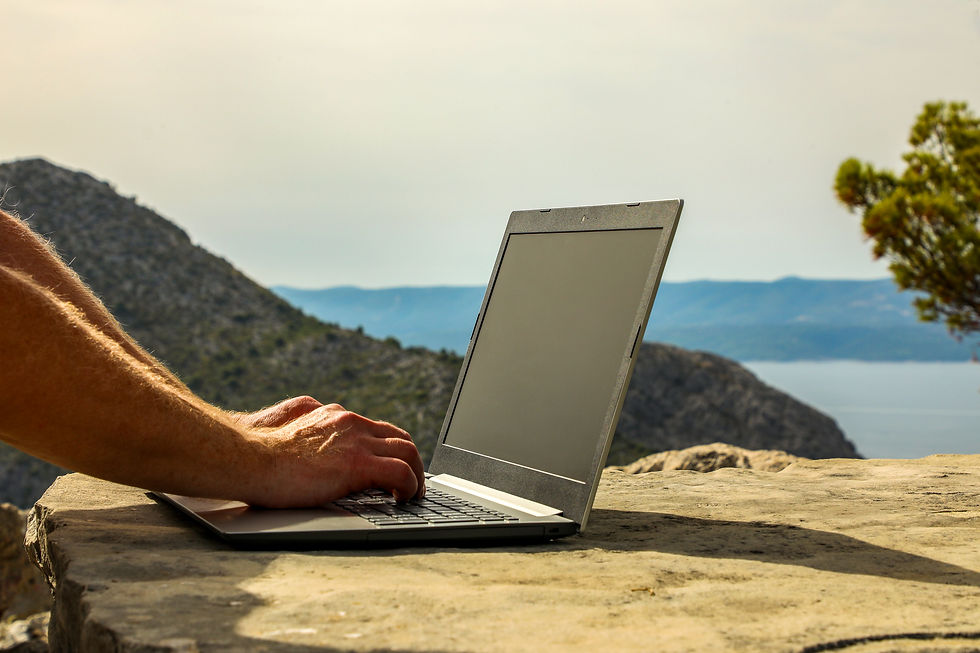
Five Questions to Ask Before Packing Your Technology
Can an iPhone and iPad replace the laptop for this particular trip?
How will I connect to the internet when hotel Wi-Fi is unavailable or unreliable?
What happens to my photographs and files if a device is lost, damaged, or stolen?
How will I protect passwords, financial information, and personal data while traveling?
Am I carrying technology because I need it—or simply because I have always carried it?
Travel technology has come a long way. These days, one phone can do more than what travelers used to pack for a whole trip. Now, we can handle reservations, boarding passes, maps, translations, banking, photos, and emergency contacts all from our phones.
Still, many travelers wonder if bringing more technology actually makes things easier. For solo travelers, every extra gadget means another charger, cable, battery, and valuable item to keep track of. The real question is not what you can bring, but what you really need.
*****
From a Suitcase Full of Technology to a Much Smaller System
My own travel tech kit has changed a lot over the years. These days, I might set out with an iPhone, iPad, laptop, external keyboard, and digital camera. Each has its role, but lugging all five makes me pause: do I honestly need every single one for every adventure?
That question becomes particularly important for solo travelers. There is nobody else carrying the second laptop, holding the camera bag while you go through security, or watching your belongings while you step away from a café table. Everything you bring remains your responsibility.
I remember traveling before any of these digital tools were around. There were no smartphones, translation apps, cloud backups, or instant hotel bookings. Now, I can land in a new country, check a map, translate a sign, message home, find a restaurant, change a reservation, take a photo of my meal, write down memories, and share everything—all with a device that fits in my pocket.
That is a huge improvement. Still, having more devices does not always make us better travelers. The big question is: Can you leave the laptop at home?
For many solo travelers, my answer is increasingly yes.
An iPhone and iPad, particularly when the iPad is paired with a good external keyboard, can now handle an impressive amount of everyday travel work. Email, web browsing, reservations, banking, maps, writing, video calls, document review, social media, photo management, and cloud storage are all easily accessible.
Modern iPads can also connect through USB-C to external storage, cameras, SD-card readers, hubs, displays, and other accessories. Apple specifically supports transferring files between an iPad and external storage, making an iPad far more useful for travel photography and file management than earlier generations.
Add a keyboard and the difference becomes even smaller. Apple's current Magic Keyboard options provide a physical keyboard and trackpad, effectively turning the iPad into a compact working station.
But that does not mean the laptop has become unnecessary.
If I know I will be doing extensive writing, managing large numbers of photographs, working extensively in several applications simultaneously, handling complicated website administration, or performing work that depends on desktop software, I still see a strong argument for carrying the laptop.
The decision should therefore happen before the trip, based on what you intend to do rather than what you might do.
For a vacation involving communication, reservations, reading, photography, light writing, and normal internet use, an iPhone plus iPad may be all that is necessary.
For a working trip involving extensive writing, publishing, professional photography, large-file management, or complicated business tasks, the laptop may still earn its place in the bag.
I also like a middle ground: bringing just an iPhone, iPad, and keyboard. This setup is much lighter but still lets me do what I need. It helps me focus on the trip, not just on keeping my laptop safe.
*****
Domestic Travel and International Travel Are Not the Same
Connectivity is where the technology equation shifts dramatically.
Within the United States, many travelers already have substantial cellular-data allowances. An iPhone can frequently become the internet connection for an iPad or laptop through its personal hotspot. Hotels, airports, cafés, libraries, restaurants, and other locations add Wi-Fi access.
International travel requires more planning.
I have previously explored several connectivity approaches on Food Blogger Journey, including dedicated mobile hotspots, international Wi-Fi devices, physical SIM cards, and increasingly convenient eSIMs. Services such as Airalo now sell local, regional, and global eSIM packages covering more than 200 locations, while Holafly offers destination plans and global options.
That creates several possible strategies.
For a short international trip, using your existing U.S. carrier's international program may be the simplest answer. For a longer trip, an eSIM can become considerably more attractive. Someone crossing several countries may prefer a regional or global eSIM. A traveler who depends heavily on internet access may want both a primary connection and a backup.
That last point is important for solo travelers.
Relying on just one way to get online in another country makes me uneasy. Internet access now ties directly to how we navigate, book, travel, communicate, and stay safe.
*****
AT&T, Verizon, T-Mobile—and Google Fi
The major U.S. carriers approach international travel differently, and there is no universal winner.
AT&T: AT&T's International Day Pass currently costs $12 per day on land for the primary line and works in more than 210 destinations. The major advantage is simplicity: eligible customers essentially continue using their existing unlimited plan abroad. The disadvantage is cost—a two-week trip can make a $12 daily charge significant compared with purchasing an eSIM.
Verizon: Verizon's TravelPass is also currently $12 per day per line in more than 210 countries and destinations. It offers unlimited talk, text, and data, although Verizon specifies 5 GB of high-speed data followed by reduced speeds during the remainder of that TravelPass session. Again, convenience is excellent, but frequent or extended international travelers should compare the total trip cost with alternatives.
T-Mobile: T-Mobile becomes particularly interesting for international travelers because qualifying plans already include international data. Depending on the plan, customers currently receive as much as 5 GB or 15 GB of high-speed data in 215+ countries and destinations, followed by lower-speed unlimited data. The advantage is that international connectivity may already be part of what you pay for; the disadvantage is that benefits vary considerably by plan, so travelers need to verify exactly what their account includes before departure.
Google Fi: Google Fi deserves consideration for frequent international travelers. Its Flexible and Unlimited Premium plans support service in more than 200 destinations, with the Unlimited Premium plan including international data while Flexible charges according to usage. The drawback is that Google Fi should not simply be treated as a temporary overseas SIM: Google requires service to be activated in the United States first, and its international service is intended for customers whose primary use remains in the United States.
My approach would be to compare the total cost of the entire trip, not simply the daily price.
A $12 charge sounds reasonable. Multiply it across fourteen or twenty-one travel days, and the comparison with an eSIM begins to look very different.

Dirk Ebener is the founder and creator behind the Food Blogger Journey website, and author of “Travel That Makes Sense”, drawing on over 40 years of international travel across more than 60 countries. His global adventures have deepened his understanding of regional cuisines, local customs, and the powerful connection between food and culture. From bustling street markets in Asia to quiet vineyard dinners in Europe, Dirk captures authentic culinary experiences through immersive storytelling. Through Food Blogger Journey, he invites readers to explore the world one dish and step at a time.
© 2025-2026 Food Blogger Journey. All rights reserved. The experiences, opinions, and photos this blog shares are based on personal travel and culinary exploration. Reproduction or distribution of content without written permission is prohibited.
Follow the journey on Instagram @FoodBloggerJourneys
Interesting Hashtags
#SoloTravel #TravelTechnology #iPad #Travel #InternationalTravel #eSIM #TravelPhotography #DataSecurity #TravelInternet #FoodBloggerJourneys #TravelThatMakesSense #SoloTraveler


Thank you for sharing the information. I will visit and travel the US in October and looking for information that I can also use when I travel in Europe. Very helpful. Danke!